The morning the lake disappeared
It started with a three-year-old.
My daughter had just turned three. Like most parents drunk on watching a small human figure out the world, I went and bought a camera. A proper one, the kind with lenses you swap and a menu of settings I didn't understand yet. The plan was simple: photograph her, keep some of it before it disappeared.
That camera opened a door I hadn't been looking for. It led me somewhere else entirely: nature photography in India.
I'd always liked being outdoors. Weekends on trails, boots muddy, that clean-lunged feeling you don't get in the city. Somewhere between bedtime routines and toddler chaos I started noticing a certain kind of photograph online. Not the ones in magazines. The ones posted by people who'd clearly dragged themselves out of bed at an ungodly hour and gone and stood somewhere cold and quiet. Golden light spilling across water. Mist curling over a valley, the sky not yet decided on what colour it wanted to be. I wanted that for myself, or at least I wanted to see if I could make it.
I picked Hesaraghatta. About an hour outside Bangalore, past the point where the roads thin out and the air changes. There's a reservoir there, a big one on the map, and I had this picture in my head of standing at the edge of it as the sun came up and fog moved across the water.
I set the alarm for a time that felt almost offensive.
Then I lay there for a good five minutes after it went off, seriously reconsidering the whole plan.
We drove out in the dark anyway, the city thinning out behind us, streetlights giving way to real dark the further we went. I had the camera, and a 10-stop ND filter I'd been wanting to try, the kind that turns seconds into minutes and smooths water into something dreamlike. November. There was a nip in the air, enough that your nose knew it first, and it smelled earthy and faintly electric, the way it only does before a city wakes up.
We parked. We walked, feet finding the path more than our eyes did.
We walked to where the lake was supposed to be.
There was no lake.
In front of us stretched a vast, pale expanse, flat and cracked in the early dark, going further than I could see. No water. No reflections. Just land wearing the clothes of a lake and not doing a very good job of it.
A man appeared out of the gloom on his morning walk, moving through the place like he owned it, which in every way that matters, he did.
"Where's the lake?" I asked.
He looked at us. Then at the emptiness. Then back at us, with the patience of someone stating the obvious.
"This," he said, "is the lake."
It had dried up completely. What used to be a reservoir was now an accidental grassland, a ghost of water wearing the shape of a field. Rising out of the cracked bed, a handful of trees, the kind that had grown up in water and were now just standing in air, roots in dust, waiting for something that wasn't coming back.
The fog came anyway.
I set up the camera. Attached the filter. Waited.
The light began, not all at once. It seeped in from the east, the faintest grey first, then a slow bloom of purple over the treeline. The mist moved through the trees the way something moves when it knows it has your attention, hiding them, then giving them back. I pressed the shutter and just stood there, watching it happen, the exposure running long, well over a minute.
The resulting photograph is called Purple Haze.
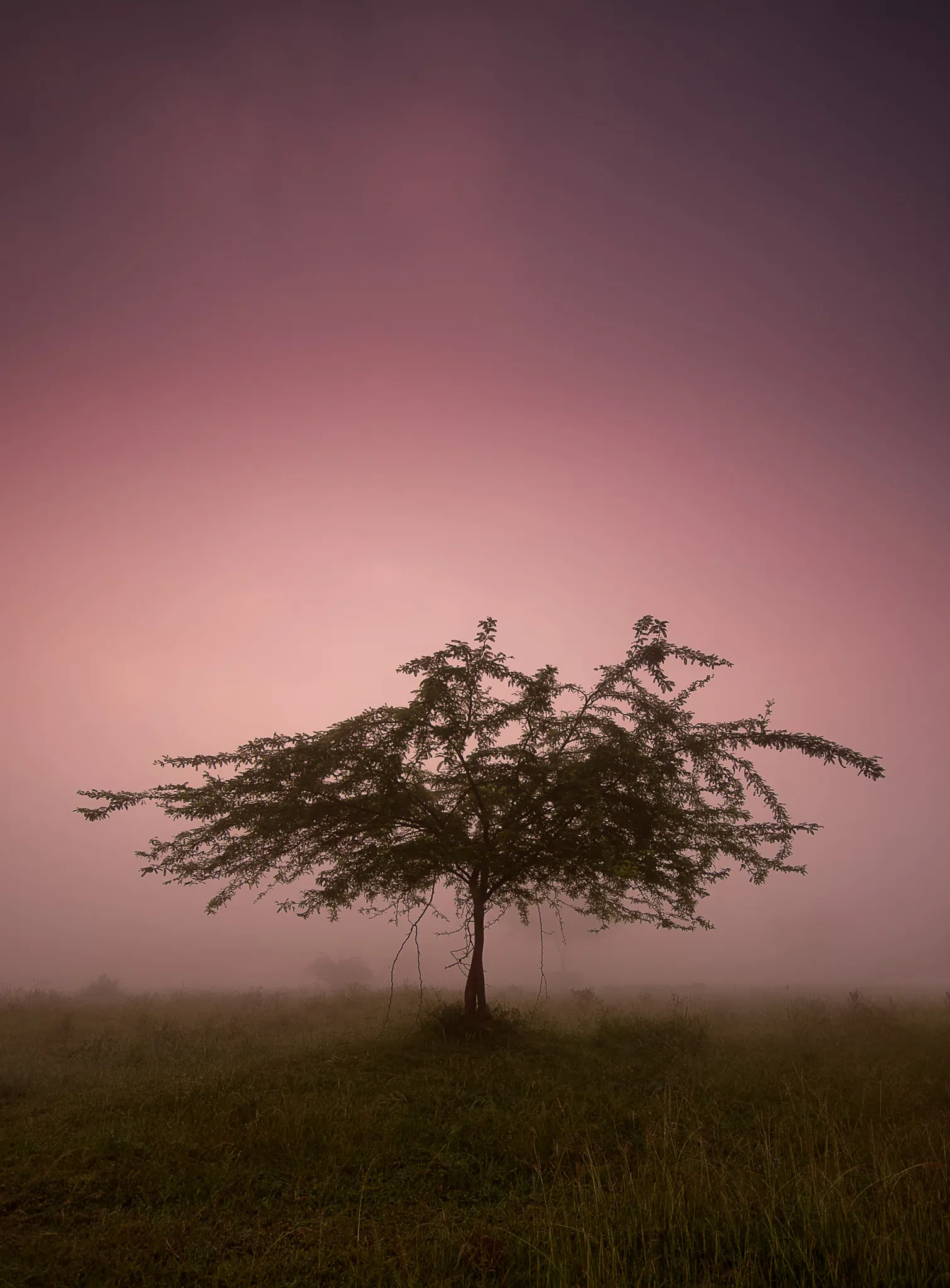
It's minimal. Quiet. A little mysterious. The fog does something I still can't fully explain, it softens the world to the point where you're not entirely sure what you're looking at, and that uncertainty becomes the whole point.
What's out there? What's hiding in the mist?
I drove home as the city was waking up, coffee gone cold, shoes damp. I sat with the image on my screen for a while before I did anything else with it. I've been back to Hesaraghatta twice since. The water was there both times.
A print of Purple Haze is available in the shop.